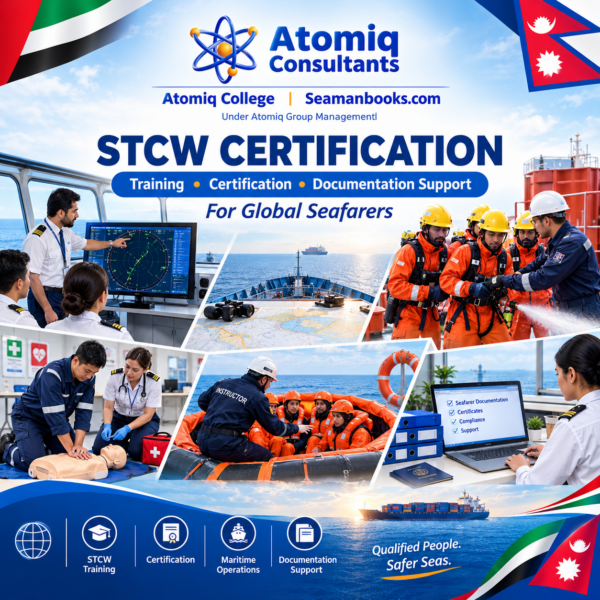
STCW Certification: Which Courses You Need and How Long They Last

STCW Certification for Seafarers

STCW basic safety training is four separate certificates — Personal Survival Techniques, Fire Prevention and Fire Fighting, Elementary First Aid, and Personal Safety and Social Responsibilities — required under Regulation VI/1 of the STCW Convention before you can work on a seagoing commercial vessel. Typically five to seven days of training when the four are timetabled as one block. Certificates are issued by an approved maritime training institute, not by a flag state and not by an agency. Atomiq College Private Limited, Kathmandu, is listed on IMMARBE’s Approved Entities register as a Maritime Training Institute of the Belize flag administration. Seaman Books, the documentation arm of the same group at #903 Regal Tower, Business Bay, Dubai, prepares the seaman book and the flag-state filings that go alongside the training.

Register your interest on WhatsApp · or send your rank and current certificate dates using the form below and we will come back with the course list your rank actually requires.

What STCW actually stands for, and what it governs

STCW is the International Convention on Standards of Training, Certification and Watchkeeping for Seafarers, adopted by the International Maritime Organization in 1978 and substantially amended since. It is the reason a certificate earned in Kathmandu means something to a master in Rotterdam: it sets one minimum standard of training that ratifying administrations agree to recognise.

What it is not: STCW is not a single certificate. There is no such thing as “an STCW card” that covers everything. It is a convention, and what you hold is a set of individual proficiency certificates issued against specific regulations within it.

That distinction matters commercially. Seafarers routinely arrive at a crewing office believing they hold “STCW” and discover they are missing two of the four basic proficiencies, or that the one they need for their rank sits under a different regulation altogether.

The four basic certificates under Regulation VI/1

Every seafarer with designated safety or emergency duties on a seagoing ship needs all four. Not three. Not “the important ones”.

CertificateCommonly calledSTCW referenceRefresher required?
Personal Survival TechniquesPSTTable A-VI/1-1Yes 
Fire Prevention and Fire FightingFPFF, basic firefightingTable A-VI/1-2Yes
Elementary First AidEFATable A-VI/1-3NO
Personal Safety and Social ResponsibilitiesPSSRTable A-VI/1-4No

Together these are what the industry calls Basic Safety Training, or BST. When a crewing manager asks whether you have “your basic”, this is the set they mean.

Is STCW the same as basic training?

Not quite. Basic training is four certificates within STCW. STCW also covers advanced firefighting, survival craft and rescue boats, medical care, security duties, radio operation, electronic chart systems and a good deal more. So every basic training certificate is an STCW certificate, but plenty of STCW certificates are not basic training.

This is a distinction worth getting right before you pay for a course, because “I need STCW” and “I need my basic” are not the same purchase.

Advanced, specialised and security certificates

Beyond the basic four, what your rank requires depends on the vessel, the role and the flag.

GroupCertificatesWho typically needs them
Advanced safetyAdvanced Fire Fighting · Proficiency in Survival Craft and Rescue Boats (PSCRB) · Medical First Aid · Medical CareOfficers, designated emergency-party leaders, and anyone in charge of a survival craft
SecuritySecurity Awareness · Designated Security Duties (SDSD) · Ship Security Officer (SSO)All seafarers need awareness; SDSD for designated duties; SSO for the appointed officer
OperationalGMDSS · Radar and ARPA · ECDIS · Bridge Resource ManagementDeck officers and watchkeepers

How long the training takes

Five to seven days for the full basic set, when a centre timetables the four courses as one continuous block. Add roughly one to two weeks after completion for certificates to be issued.

Door to door — first enquiry to certificates in hand — a normal case runs two to four weeks. It runs longer when a seafarer medical has to be booked from scratch, or when the next intake is full.

Do the four together, at one centre, in one block. Splitting them across centres or across months produces certificates with mismatched issue dates, which complicates every renewal you will do for the rest of your career and occasionally slows a port state control inspection.
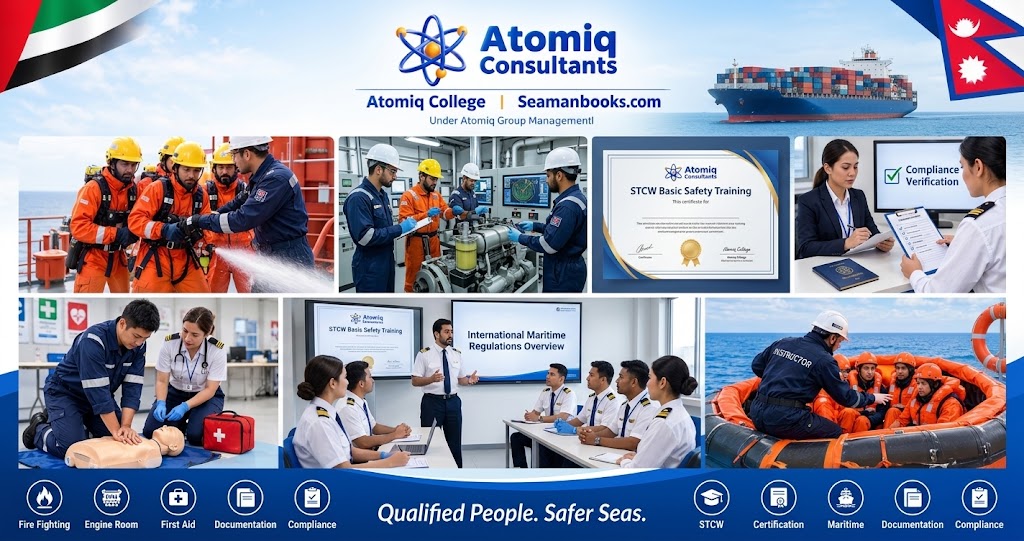
STCW Certification and Training

What it costs

There is no single STCW price, and anyone quoting you one without asking your rank is guessing.

What moves the number: how many modules you actually need, whether Security Awareness is bundled or priced separately, which centre and which intake, and what sits around the training — a seafarer medical, the seaman book application and any flag-state endorsement are separate costs from separate parties.

Send your rank, the modules you think you need and your target join date on WhatsApp, and you will get the institute’s own fee for your case before you commit to anything.

Who delivers the training

This is the part most agency pages leave vague, so here it is plainly.

A training institute delivers the course and issues the certificate. A flag state recognises it. An agency does neither.

Atomiq College Private Limited is the maritime training institute of Atomiq Group, based at 04 Pasikot, Chapali, Budhanilkantha, Kathmandu, Nepal. It is listed on the International Merchant Marine Registry of Belize (IMMARBE) Approved Entities register, under Maritime Training Institutes.

Seaman Books is the documentation side of the same group, at #903 Regal Tower, Business Bay, Dubai. We prepare and file seaman book applications with flag-state administrations, and we coordinate the documentation that has to line up with your training. We do not issue certificates, we are not a flag state, and we cannot promise a government outcome.

The certificate is not the endorsement

A point that costs seafarers joining dates more often than any other in this cluster.

Your training certificate proves you completed the course. For several flag states, the document a ship actually needs to see is the flag state’s own endorsement of that certificate — a separate document, with its own application, its own fee and its own processing time. A seafarer can hold a perfectly valid certificate and still be turned away because the endorsement was never applied for.

If you are joining a Belize, Panama, Palau, Liberia, Bahamas, Honduras or St. Kitts & Nevis flagged vessel, check which of your certificates need endorsing before you book a flight. That is the part we handle.

Can you get STCW certification online?

No — not the basic four. Personal Survival Techniques requires you to be in the water. Fire Prevention and Fire Fighting requires live fire. Elementary First Aid requires assessed practical demonstration. A certificate issued for these without attendance is not a valid STCW certificate, whatever the website selling it says, and a port state control officer who spots one creates a problem that follows the seafarer for years.

Some theory components can be delivered as computer-based training within an approved centre’s programme. That is not the same thing as an online certificate, and it is worth being suspicious of anyone who blurs the two.

Who needs STCW certification

Anyone with safety or emergency duties on a seagoing commercial vessel: deck officers and engineers, ratings and support crew, marine safety officers, cruise ship service staff, and crew on offshore support vessels.

If you are heading to a rig rather than a vessel, STCW is probably not the certificate you need. Offshore work runs on OPITO standards — BOSIET, HUET, FOET — which are a different regime with different centres. Those are covered separately in offshore training courses.

STCW Courses


Why Do You Need STCW Certification?

Without STCW certification, you won’t be able to work on most seagoing vessels. More importantly, the STCW certificate gives you the skills and knowledge needed to handle onboard challenges, respond to emergencies, and ensure the safety of the crew and passengers. It’s a must-have for anyone serious about advancing their maritime career.

With an STCW certificate, you can:

  • Access Global Job Markets: Employers worldwide recognize the STCW certification as the gold standard in maritime training.
  • Boost Career Opportunities: With the right certifications, you can qualify for higher positions on international vessels.
  • Ensure Compliance: Stay compliant with IMO regulations, protecting yourself from legal issues and ensuring job security

Why Choose Atomiq Group for Your STCW Certification?

Atomiq Group is a trusted partner for maritime professionals seeking certification. We offer a fast, reliable, and straightforward process to get your STCW certification, helping you focus on your career goals.

Here’s what makes us the top choice:

  1. Industry Experts: Our team has years of experience in maritime documentation and training, making sure your certification process is smooth and efficient.

  2. Global Network: We work with accredited training centers worldwide to ensure that your STCW courses are recognized and up-to-date with the latest standards.

  3. Comprehensive Support: From initial application to receiving your certificate, we handle every step of the process, offering full support along the way.

  4. Affordable Solutions: We offer competitive pricing without compromising on quality, giving you access to top-tier training at an affordable rate.

  5. Fast Turnaround: With our streamlined process, you can get your STCW certification quickly and efficiently, ready to take on new opportunities.

How to Get STCW Certified with Atomiq Group?

Applying for your STCW certification through Atomiq Group is easy. Here’s how:

  1. Submit Your Inquiry: Contact us through our website or give us a call. Our experts will guide you through the qualifications required and courses needed.

  2. Enroll in Training: We’ll connect you with approved training centers that offer the required courses, such as Basic Safety Training (BST), Advanced Firefighting, and Medical First Aid.

  3. Complete Your Training: Once enrolled, complete the necessary modules, including practical exercises to ensure you are fully prepared for onboard challenges.

  4. Receive Your Certification: After successful completion of your courses, Atomiq Group will handle the documentation and ensure you receive your STCW certificate promptly.

Who Needs STCW Certification?

STCW certification is required for anyone working on commercial vessels, including:

  • Deck officers and engineers

  • Ratings and support crew

  • Marine safety officers

  • Cruise ship staff

  • Offshore workers

Whether you’re new to the industry or looking to upgrade your certifications, Atomiq Group can help you get the training you need to succeed.

The courses offered are as followed:

Basic Training Courses:

  • Basic Firefighting

  • Personal Survival Techniques

  • Personal Safety and Social Responsibilities

  • Elementary First Aid

Advanced Training Courses:

  • Advanced Firefighting

  • Proficiency in Survival

  • Craft and Rescue Boats

  • Medical First Aid

  • Medical Care

Specialized Training Courses:

  • GMDSS (Global Maritime Distress and Safety System)

  • Radar and ARPA (Automatic Radar Plotting Aids)

  • ECDIS (Electronic Chart Display and Information System)

  • Ship Security Officer

  • Bridge Resource Management

Refresher Courses:

  • Basic Training Refresher

  • Advanced Firefighting Refresher

  • Proficiency in Survival Craft Refresher

Offshore courses:

1. Basic Safety and Emergency Training:
    a. Basic Offshore Safety Induction and Emergency Training (BOSIET)

    b. Further Offshore Emergency Training (FOET)

    c. Helicopter Underwater Escape Training (HUET)

2. Maritime and Survival Training:
    a. Personal Survival Techniques (PST)

     b. Proficiency in Survival Craft and Rescue Boats (PSCRB)

      • Security training for seafarers with Designated security duties

      • Ship cook course according to maritime labor convection,2006

      • Elementary first aid

      • Personal survival techniques

      • Personal safety & social responsibilities

      • Fire prevention & Fire fighting

The following courses meets the requirements:

  • The Competence standards given in Table A-VI/6-1 & Table A-VI/6-2of the section A of the STCW code.

  • The Minimum requirement of rule 3.2, Standard A3.2and guideline B3.2 of the maritime labor Convention,2006.

  • In Accordance with the IMO regulation VI/1,Section A-VI/1 Paragraph 2.1,Table A-VI/1-1, Table A-VI/1-2, Table A-VI/1-3 and Table A-VI/1-4 Of the STCW Convention and code 2010, Applicable to the issue of the certificate.

This course was developed in response to the demand for Standards of Training certification and Watchkeeping for seafarer shipping.

We offer the courses related to STCW from the following countries India, Nepal which also includes Gulf Cooperation Council Saudi Arabia, Kuwait, the United Arab Emirates, Qatar, Bahrain, and Oman.

Conclusion

Today’s seafarer must have his skills in an increasingly complex and commercial shipping environment. The STCW regulations underline quality training and certification of sea personnel for safer ships. The shipboard automation, electronics and satellites has resulted in the demand for personnel of high caliber to man modern ships, a demand far outpacing supply. This makes the task of training institutions more exacting and precise.

Frequently Asked Questions

What is an STCW certificate?

An STCW certificate is proof that a seafarer has completed a specific training course meeting the minimum standard set by the IMO’s STCW Convention. It is issued by an approved maritime training institute, not by a flag state, and it is recognised internationally by administrations that have ratified the convention.

What does STCW stand for?

Standards of Training, Certification and Watchkeeping. The full name is the International Convention on Standards of Training, Certification and Watchkeeping for Seafarers, adopted by the International Maritime Organization in 1978 and amended since, most substantially in 2010.

How many STCW courses are there?

Basic safety training is four: Personal Survival Techniques, Fire Prevention and Fire Fighting, Elementary First Aid, and Personal Safety and Social Responsibilities. Beyond those, the convention covers advanced, specialised and security proficiencies — the number you personally need depends on your rank and vessel type.

How long does STCW training take?

Five to seven days for the full basic set when a centre runs the four courses as one block, plus roughly one to two weeks for certificates to be issued. First enquiry to certificates in hand is normally two to four weeks.

Is STCW basic training the same as a seaman’s book?

No. They are two separate documents from two separate bodies. Training certificates come from an approved institute; the seaman’s book, or CDC, is issued by a flag-state administration and has its own eligibility requirements. Most flag states want to see your basic training before they will process the book — see seaman book requirements.

Does an STCW certificate expire?

Several of the safety proficiencies must be refreshed on a five-year cycle, and a lapsed certificate can stop a joining even when everything else is in order. [Basic Training Refresher, Advanced Firefighting Refresher and Proficiency in Survival Craft Refresher which proficiencies carry the five-year updating requirement,] What to do about an expired one is covered in STCW renewal.

Who issues the certificate — do you?

The training institute does. Seaman Books is a documentation consultancy: we confirm which courses your rank requires, arrange the enrolment, and prepare the flag-state filings that go with it. Atomiq College Private Limited, the training institute of the same group, is listed on IMMARBE’s Approved Entities register as a Maritime Training Institute in Nepal.

Tell us your rank and your certificate dates, and you will get back the exact course list your rank requires — not a brochure.

WhatsApp the Dubai desk · #903 Regal Tower, Business Bay, Dubai

نموذج الاتصال